
Swiss Screw Machining
High quality Swiss screw machining is the answer when you need small precision parts with exceptional dimensional accuracy and tight precise tolerances. The best professionals in the metal machining industry work with Swiss screw machines to plan, produce, and machine parts that meet the requirements of your assemblies.
The excellence of Swiss screw machining was discovered over a hundred years ago when Swiss clock makers required precision parts. Their demand led to the introduction of the Swiss screw machine, which has grown and expanded into a wide array of industrial operations.
The Swiss Screw Machine Difference
- Cuts within tolerances of 0.0002 inch
- Depending on the complexity of a part, can produce 30 parts per hour
- Capable of producing highly complex parts
- Produces, significantly less bending and a very low deflection
- Highly efficient
- Short cycle times resulting in time savings and fast turnaround times
- Allows for micrometer adjustments on tool holders.
- Short tool throws and high rigidity
- High precision output
- Workpieces move axially creating features along the length of the workpiece, instead of moving the cutting tool.
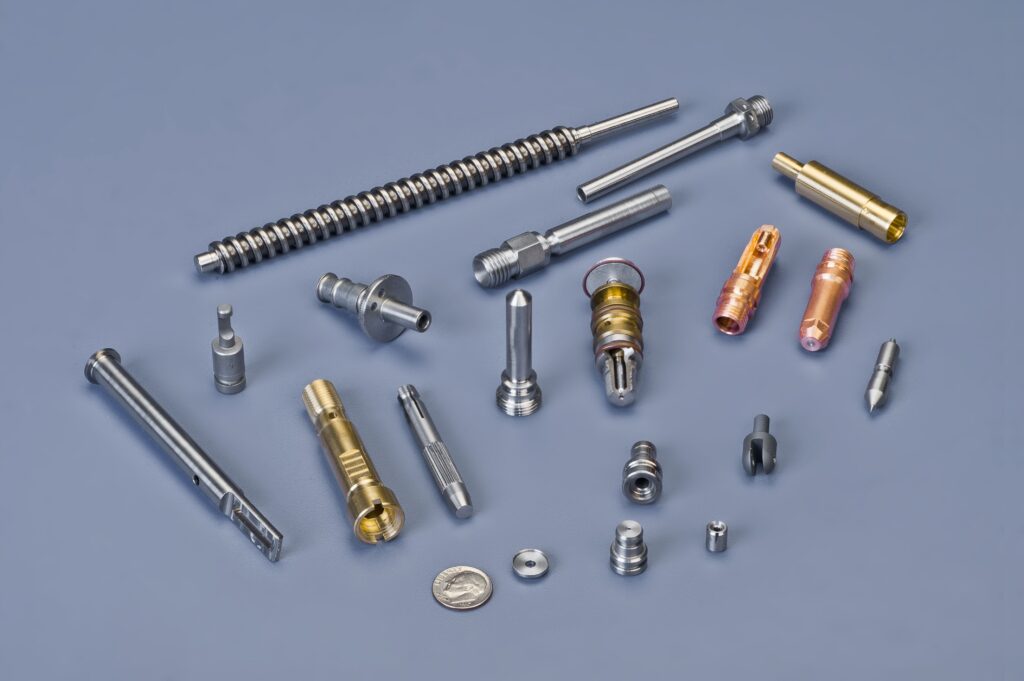
Swiss screw machines allow designers to manufacture highly complex parts of a few hundred or several thousand that require multiple machining operations. Milling, drilling, threading, boring, turning, and custom machining can easily be performed for high volume production runs. Workpieces can vary from 3/32″ inches in diameter up to 1 1/4″ inches in diameter.
Any metal that can be machined can be machined using a Swiss screw machine. From stainless steel to titanium, a Swiss screw machine can be programmed to cut, shape, and form perfect parts, every time. This level of exceptional performance has made Swiss screw machines the standard for modern metal machining. Perfected, enhanced, and improved Swiss screw machines are able to produce refined, three-dimensional parts by simply pushing a single button. Complex geometries are produced by feeding raw feed stock that is transformed, in a single operation, into a finished part.
Computer Numerical Control (CNC) Machining has moved Swiss screw machines from their origins into the modern era. Using a set of computer-generated G and M codes, Swiss screw machines can be programmed to perform a wide array of complex machining operations using mounted tools. All that a customer has to do is provide a computer rendering, which machining experts use to program Swiss screw machines. In a short time, the rendering of a design engineer is transformed into a viable precision part.
Swiss Screw Machine Computer Numerical Control (CNC) Machining
- 2 dimensional draws or 3 dimensional models.
- Metal machining company converts design into CNC codes
- CNC codes are programmed into a CNC Swiss screw machine
- CNC Geometric or G codes direct tool movement and function
- CNC Miscellaneous or M codes control and direct machine operations
- Inserted metal rods are transformed into high tolerance viable parts
Highly qualified metal machining companies use their expertise and knowledge of Swiss screw machining to meet customer requirements. The quality and precision of components produced by Swiss screw machines is meets and exceeds industry standards. The many benefits of Swiss screw machines and their reliability is what differentiates metal machining companies.
Factors for Choosing a Swiss Screw Machine Company
While many machining companies may advertise their abilities, highly qualified companies have the support of their customers. The factor that sets a company apart is their knowledge of their industry and their performance, which is found in customer satisfaction.
- Experience – Swiss screw machining depends on the skills and abilities of workers and their years of experience.
- Equipment – Only the latest and technologically advanced Swiss screw machines can produce proper dimensional accuracy and tolerances.
- Certifications – The International Organization of Standardization (ISO) and the American Society of Testing and Materials (ASTM) certify Swiss screw machining manufacturers that produce high quality products and provide exceptional service.
- On Time – On time delivery, every time, is the mark of an outstanding Swiss machining company.
- Collaboration – Modern metal machining is a collaborative effort between producer and customer.
- Location – As offshoring has peaked and is dwindling, clients and customers are relying on local metal machinists to produce their products.
- Cost – High quality Swiss screw machining companies are able to meet customer demands for efficiency and quality at a cost that customers require.
High Accuracy Machining for Small, Complex Parts
Swiss screw machining is designed for components that require tight tolerances, stable dimensional control, and consistent performance across large or recurring production runs. The process supports intricate geometries by guiding the bar stock through a sliding headstock, allowing the workpiece to move axially while the cutting tools remain rigidly supported. This configuration minimizes deflection and enables precise machining along the entire length of the part.
CNC Integration for Complex Geometries
Modern Swiss machining incorporates CNC control, allowing machines to execute complex tool paths using programmed G and M codes. Design files, whether two dimensional drawings or three dimensional models, are converted into machine instructions that guide tool movement, spindle coordination, and auxiliary functions. This integration supports repeatable production of intricate parts with minimal manual intervention.
Applications Across Precision Driven Industries
Swiss screw machining is widely used in medical devices, instrumentation, aerospace components, automotive systems, and industrial assemblies. The process is particularly effective for parts that require multiple features, tight tolerances, or long, slender geometries that would be difficult to machine on conventional turning equipment.
FAQ
What Types of Parts Are Best Suited for Swiss Screw Machining?
Swiss machining is ideal for small components with tight tolerances, long length to diameter ratios, or multiple features that must be produced in a single setup. It is commonly used for precision pins, fittings, fasteners, and miniature assemblies.
How Does Swiss Machining Maintain Tight Tolerances?
The sliding headstock design supports the bar stock close to the cutting tool, reducing deflection and vibration. Short tool throws and rigid tool holders further enhance dimensional stability.
Which Materials Can Be Machined on Swiss Equipment?
Materials include stainless steel, aluminum, brass, copper, titanium, and alloy steels. These machines are capable of producing consistent results even with materials that require controlled cutting conditions.
What Role Does CNC Programming Play in Swiss Machining?
CNC programming defines tool paths, spindle coordination, and machine functions using G and M codes. This allows complex geometries to be produced accurately and repeatably from digital models.
Conclusion
When a design requires a small precision part with exceptional dimensional accuracy and high tolerance, the first and only choice is a Swiss screw machine. For centuries, Swiss screw machines have produced small parts and components efficiently. In the modern era, the machines have been upgraded and improved by the addition of CNC programming that makes production swift, smooth, and reliable.